Delta, tadpole or folding? Judge each one by whether it gets through your front door
How the three common adult trike layouts compare on turning circle, seat height, camber behavior and folded footprint, measured against a rowhouse hallway and a basement stair.
Common questions
Four numbers to write down
Before shopping, measure the front doorway, the narrowest point of the hallway, the width of the basement stair, and the headroom at the top of that stair. Those four figures rule out more models than any spec comparison will.
Widest point is the axle
On a delta the rear hub-to-hub distance sets the squeeze; on a tadpole it is the front axle. Fenders, pedals and mirrors can add several inches that manufacturer figures sometimes include and sometimes do not.
Doorways are rarely the pinch
Most hallways narrow somewhere past the door, at a radiator, a stair newel post or a coat hook. Measure at the tightest point along the whole route, not just at the entrance.
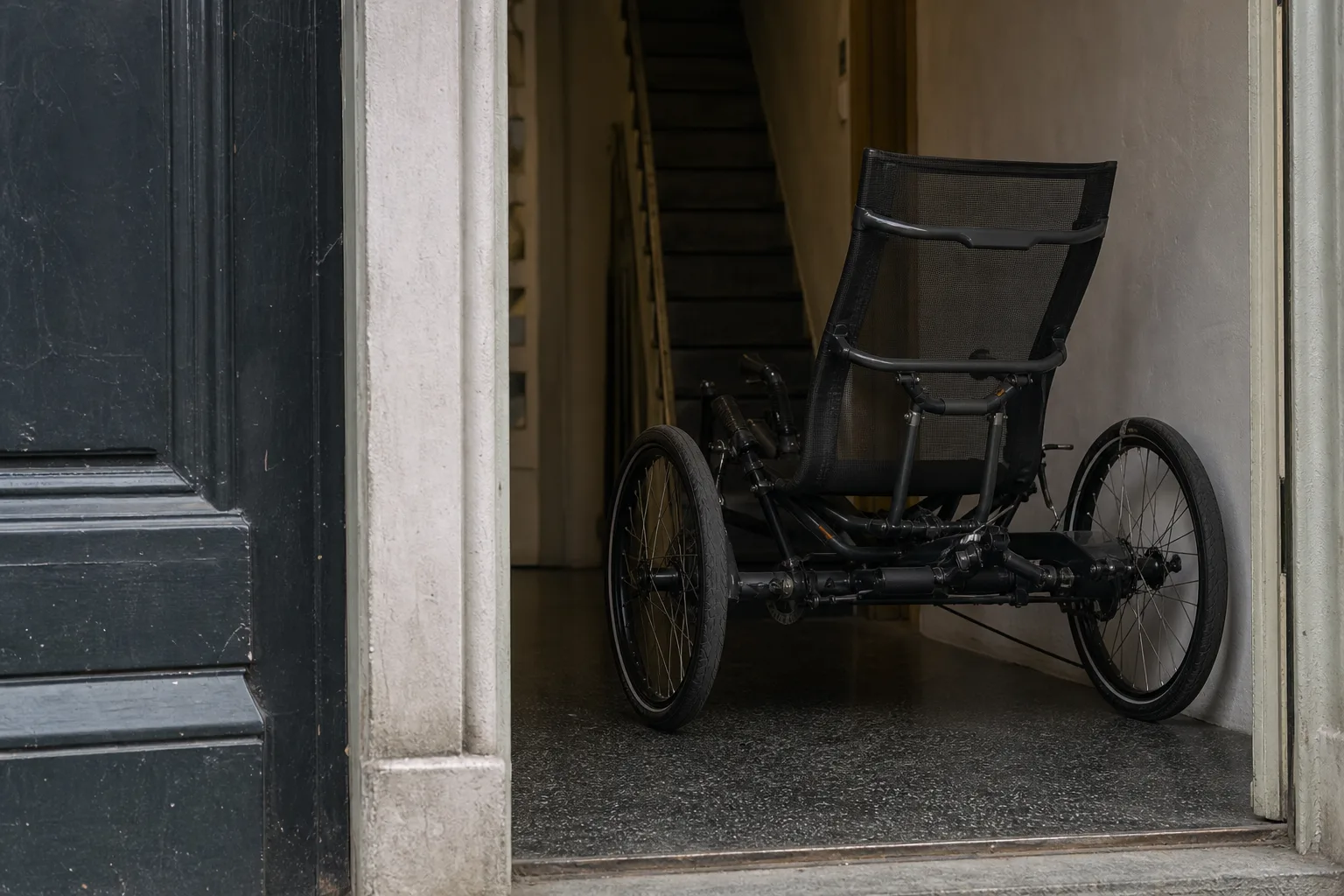
Delta seat height
Delta trikes place the rider at roughly conventional bicycle saddle height, which makes mounting from a curb straightforward. The tradeoff is a higher center of mass on a crowned street.
Storage decides more trike purchases than ride quality does, and it decides them after the money has been spent, which is the wrong order. A machine that handles beautifully on Spring Garden and then lives chained to a stoop is a machine you will use less each month. So before comparing layouts on how they steer, it is worth carrying a tape measure to the front door, the hallway, the turn at the bottom of the stairs, and the basement landing, and writing four numbers on a piece of paper. Everything below is easier once those numbers exist.
The three layouts, described by the part that gets stuck
A delta trike has one wheel in front and two behind, an upright seat, and a rear axle that is the widest thing on the frame, usually somewhere between thirty and thirty-four inches across the hubs. A tadpole has two wheels in front and one behind, a low recumbent seat, and its width sits at the front axle, often a little wider still, with the length running long behind you. A folding trike is usually a delta whose rear frame hinges, or whose axle assembly drops out, trading a few pounds of hardware for the ability to become a shape that fits somewhere. Each layout gets stuck at a different point in the same hallway.
Turning circle and what a rowhouse hallway allows
Turning circle on the street and turning circle in a corridor are separate problems. Deltas steer from a single front wheel and pivot tightly on pavement, but the rear axle sweeps wide, so pushing one into a hall narrower than about forty inches means walking it in straight and lifting the back end around the newel post. Tadpoles steer from the front pair and need real road width to come about, though indoors they behave better than expected because the long tail follows the front rather than swinging. Measure the hallway at its tightest point, which is almost never the doorway itself, and compare it against the axle width plus your knuckles.
Seat height, camber, and the way a trike leans on a crowned street
Philadelphia streets are crowned for drainage, and a trike does not lean into a camber the way a two-wheeler does, so the load simply shifts toward the downhill wheels. Tadpole seats sit low, often at or near knee height, which puts the center of mass under the axle line and makes the machine feel planted through a cambered turn. Delta seats sit high, closer to a conventional bike saddle, which is easier to mount from a curb but raises the point at which an outside wheel starts to unweight. The Consumer Product Safety Commission oversees bicycle safety standards for machines sold in the United States, and stability behavior is worth asking a dealer about directly. Slower cornering and a load carried low in the rear basket solve most of it.
Folded footprint, measured against a basement stair
A folding claim is only useful as three numbers: width, height, and length in the folded state, plus the weight you will actually be lifting. Basement stairs in older rowhouses are frequently under thirty inches wide with a turn at the bottom and a low header at the top, so a folded package thirty-six inches long can still refuse the corner. Weight matters more than the brochure suggests, because a fifty-pound folded delta is a two-person carry down a narrow stair and a one-person carry across a flat garage floor. If the fold does not clear the stair, a ground-floor solution, a wide vestibule, a rear yard shed, a shared bike room, is the honest answer. Battery removal helps: most electric assist packs come off and go inside separately, which takes several pounds out of the lift and keeps the cells at room temperature.
What a careful reader checks before paying
Ask the seller for axle width at the widest point rather than overall width, since fenders and pedals add inches that a spec sheet may quietly include or exclude. Ask whether the fold requires tools, how long it takes cold and with gloves on, and whether the frame stands upright once folded or has to lie down. Bring the tape measure to the test ride and put it across the demo machine yourself. Then walk the route from curb to storage spot at home, counting turns, and decide which layout survives it. That single walk settles the question more reliably than any comparison chart.
The layouts are genuinely different animals, and the right one is whichever fits the path you already have. Measure first, ride second, and the machine you buy will be the one you keep using through February.
A tadpole recumbent seat typically sits near knee height, putting the rider's weight low and between the front wheels. Getting in and out takes practice, and traffic sightlines are lower than drivers expect.