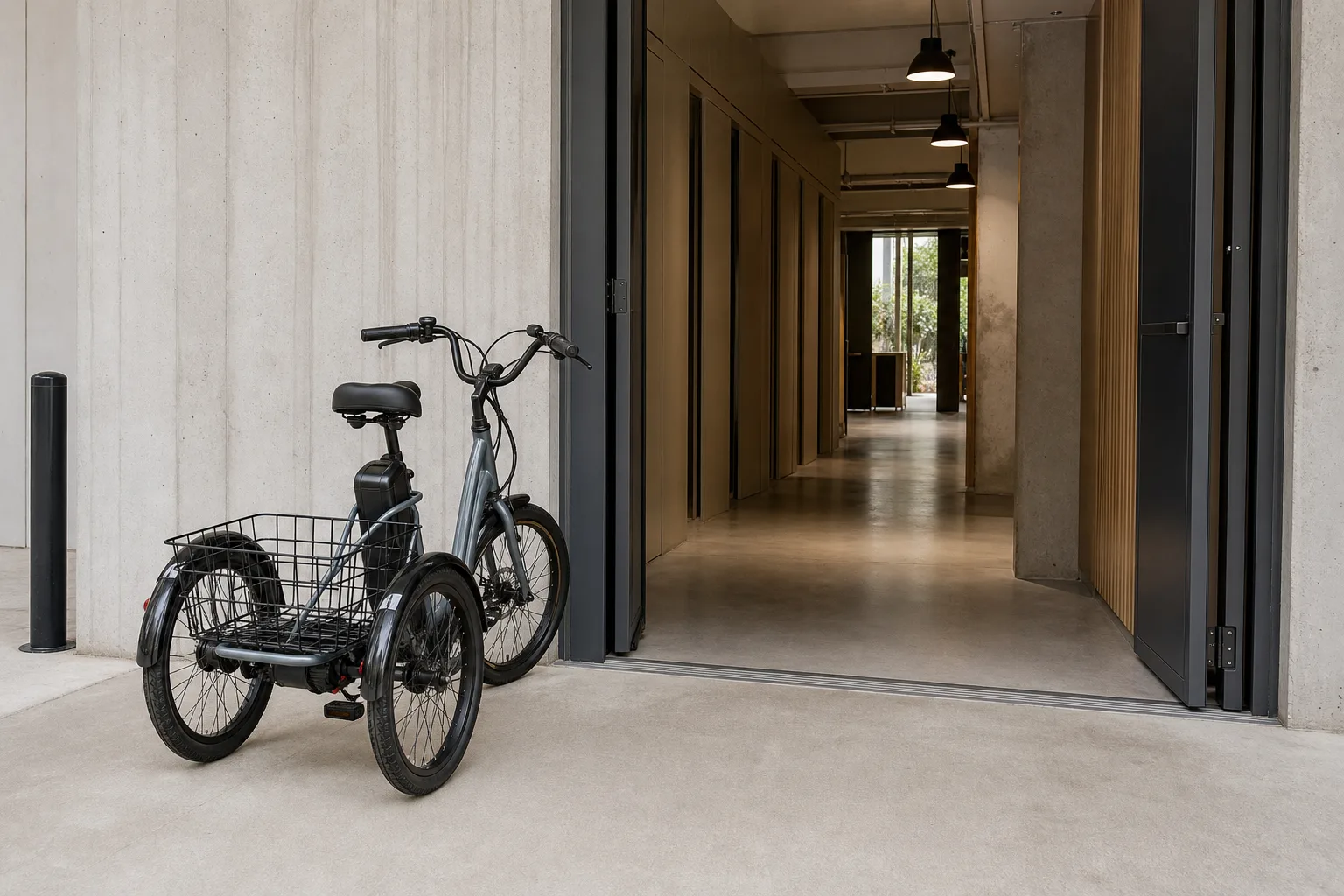
One rider's findings after test-riding delta, tadpole and folding trikes around the city and reading the manuals that came with them. Nothing here is sponsored and nothing is for sale.
The reason people buy an adult trike is almost never the reason they tell you first. They say they want the cargo basket, or the electric assist, or something they can ride to the store. Underneath that is usually a specific moment: a foot that did not come down fast enough at a light, a wrist that took the weight of a bike falling sideways, a diagnosis that made two wheels feel like a bet rather than a ride. The third wheel removes that bet. It also changes the geometry of every trip you take afterwards, and the sooner you price that in, the better the purchase goes.
What the third wheel actually buys you
Three things, and they are worth naming separately because riders weight them differently. First, the machine stands up on its own, at a light, on a hill, in a crosswalk full of people, without any input from your legs or your inner ear. Second, you can stop and start without unclipping, dabbing, or planning the stop half a block out, which is the single largest change to how a city ride feels. Third, the rear axle carries weight the way a bike frame never will: a full basket of groceries, a folded stroller, a case of water, all sitting behind you instead of pulling on the bars.
For riders with vestibular issues, peripheral neuropathy, a hip replacement or simple age-related loss of quick balance recovery, the first two of those are not conveniences. They are the difference between riding and not riding. That is the honest case for a trike, and it holds up. The Consumer Product Safety Commission is responsible for the federal requirements that govern bicycles and tricycles sold in the United States, which is why a mass-market trike arrives with reflectors, a chain guard and a braking specification rather than a shrug.
Thirty-two to thirty-six inches, and everywhere it does not fit
Track width is the number to write down before you write a check. Most adult trikes measure something between 32 and 36 inches across the rear axle, and a few cargo-oriented models run wider. A standard interior door in an American house or apartment gives you about 30 inches of clear opening, sometimes 32. Do that subtraction once and the consequence is obvious: the machine that fixed your balance problem now cannot follow you into the kitchen, down the hallway, or into the back bedroom where the old bike lived on a hook.
The same arithmetic applies outdoors, in less forgiving form. A gap between two parked cars that a bike threads without slowing becomes a stop-and-reverse maneuver. A bike lane pinched by a delivery truck leaves you choosing between the travel lane and the curb, because you cannot ride the painted line the way a narrow machine can. Bollards, gate posts, the chicane at the entrance to a park path, and the turnstile-style barrier on some trail heads were all sized for two wheels. Ride your intended route once on a rented or borrowed trike and you will find every one of them in an afternoon.
Cornering is a different skill, not a harder one
A bicycle turns by leaning; a trike turns by steering, and your body stays upright while the machine changes direction underneath you. That means speed into a corner has to come off before the corner, not during it, and it means the inside rear wheel will lighten if you carry too much. Riders coming from a lifetime on two wheels usually spend the first two weeks fighting the instinct to lean, then stop noticing. A tadpole layout, with two wheels forward, is markedly more stable in a fast turn than a delta with two at the back, which is a real reason to test both rather than order the one that looks familiar.
The other adjustment is the crown of the road. Most streets are built to shed water, so the surface tilts toward the gutter, and a three-wheeled machine feels that tilt in a way a bicycle simply corrects for without telling you. You will steer slightly uphill on a crowned street. It is not difficult and it is not dangerous, but nobody mentions it, and one owner writing honestly about what surprised him after buying an e trike put road camber near the top of his list.
What it costs beyond the purchase price
Budget for storage before you budget for accessories. In a rowhouse or a walk-up, the realistic answers are a ground-floor space with a wide door, a shed or garage, a stair-free side entry, or a folding frame that collapses to something two people can carry. Each of those has a price: a folding model costs more and weighs more, a rented garage bay is a monthly line item, and a curbside cover plus a serious lock is the cheapest option and the one most exposed to weather and theft.
Then add the parts that a bike shop may not stock. Trikes use axle assemblies, differentials or freewheel clusters, and rear wheels that are not interchangeable with bicycle stock, so a flat on the rear can mean a wait rather than a walk-in. Ask any shop you plan to rely on whether they service three-wheeled machines at all, and ask before you buy, not after.
The trade is legible once you say it out loud: you are exchanging the ability to squeeze through gaps for the ability to stop anywhere, carry anything, and never put a foot down. Riders who measure their doorway, their route and their storage first tend to be the ones still riding a year later.